
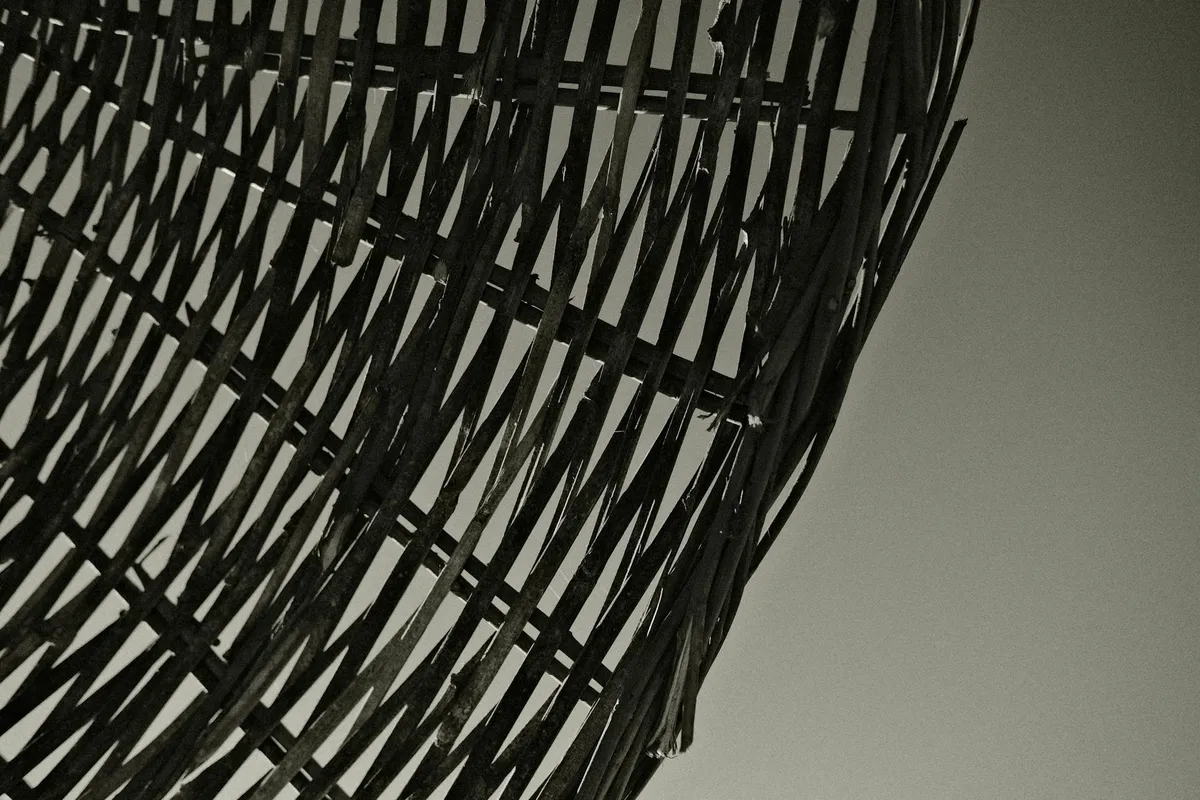
Decorative motifs on woven baskets travel. Construction techniques do not — at least not nearly as far or as fast. A basket's weave structure, its starting coil, its stitching pattern, and its rim treatment are far more reliable indicators of regional and community attribution than what is painted or dyed on the surface. A short tour of how to read what is in front of you.
Twined vs. coiled — the foundational distinction
The first determination is structural: is the basket twined or coiled? Twined baskets are built with two or more weft strands twisting around vertical warp elements; the surface shows a diagonal or horizontal ribbing depending on twining direction. Coiled baskets are built by stitching a continuous coil of bundled grass, willow, or sedge into a spiral; the surface shows the coil and the stitches binding it. Pacific Northwest and Northern California traditions are predominantly twined. Southwestern and Great Basin traditions are predominantly coiled. Plains traditions include both but in distinct forms.
The starting coil tells you the maker's school
On a coiled basket, the very centre — the starting coil — is where regional schools become most visible. A coil that starts as a small flat disc and spirals outward is characteristic of some traditions; a coil that starts as a tight knot and is built outward in stacked layers is characteristic of others. The starting coil is often the part that has been most lovingly attended to; it is also the part dealers most often crop out of photographs because it requires the most expertise to read.
Stitching pattern: interlocking vs. non-interlocking
Within coiled baskets, the stitches that bind each coil to the one below it can either pass through the previous stitches (interlocking) or beside them (non-interlocking). The distinction is invisible from a distance and definitive up close. Interlocking stitching is structurally tighter and characteristic of some communities; non-interlocking is more characteristic of others. A 10x loupe and good light make this visible in a minute.
Rim treatment: the maker's signature
Many basket-makers treated the rim as the most visible expression of their skill, and rim treatments — false braid, herringbone, "ticked" rim — are often regionally diagnostic. Sometimes a rim style is so specific that it can support attribution to a single community even when the rest of the basket has been altered by use or repair.
What this means for catalogue writing
A catalogue entry that describes a basket as "Native American, Western, early 20th century, with geometric design" is doing less work than the basket deserves. An entry that records "Twined, single-pair Z-twist with overlay decoration, two-rod rim with self-edge; consistent with Hupa or Karuk attribution" is making a falsifiable claim that another researcher can verify, dispute, or refine. The second is the standard.