One of the most common errors in catalogue descriptions of Southwestern Native American pottery is to lump Pueblo and Diné (Navajo) work together. The two traditions are distinct in clay, firing method, surface treatment, and form, and the visual cues separating them are learnable in an afternoon of looking.
Pueblo pottery is coil-built, slip-painted, and pit-fired
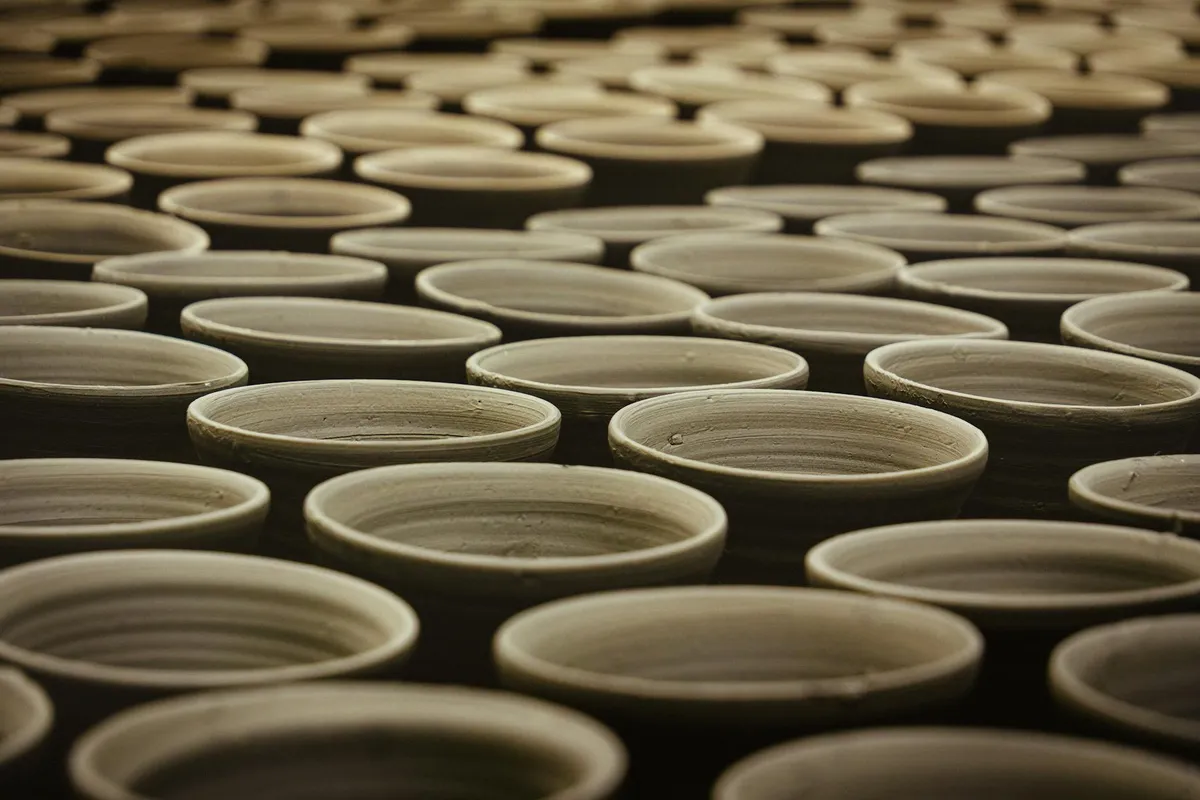
Pueblo traditions — San Ildefonso, Santa Clara, Acoma, Hopi, and others — build vessels by coiling ropes of clay and scraping them smooth. The surface is typically burnished with a stone, slipped (a thin layer of fine clay applied as a wash), and decorated with mineral or plant-based pigments before pit-firing. Famous matte-on-polished black wares from San Ildefonso are produced by smothering the fire to deprive it of oxygen — a reduction firing that turns the iron in the clay black. The forms tend toward closed shapes: water jars, seed jars, storage vessels. Painted decoration is highly developed, with each Pueblo carrying recognisable motifs.
Diné pottery is hand-built, pinon-pitch coated, and lower-fired
Historic Diné pottery is functionally and visually different. It is hand-built rather than tightly coiled, generally undecorated or sparingly decorated, and characteristically coated after firing with a layer of melted pinon pitch (sap), which gives the surface a warm brown, slightly tacky sheen and helps waterproof the vessel. The forms tend to be utilitarian — cooking pots with pointed bases, storage jars — and the firing is typically lower-temperature than Pueblo work. The pitch coating is the single most reliable visual identifier.
What confuses the two in practice
Twentieth-century revivals on both sides have produced cross-pollinated work, and a mid-century Diné decorative piece made for the tourist market may borrow Pueblo forms. Conversely, some contemporary Pueblo artists have experimented with pitch coating. The reliable approach is to look at construction first (coil-and-scrape vs. pinch-and-build), surface treatment second (burnished slip vs. pitch coat), and decorative tradition third — never decoration first, because decoration is the most easily copied element.
A note on language and attribution
Whenever possible, describe pottery by community of origin — San Ildefonso, Acoma, Diné — rather than by region. "Southwestern pottery" is acceptable as an umbrella but should never appear in a label where a specific community can be named. Many pieces in private collections have been attributed only to "Pueblo" because the dealer either did not know or did not care to find out; a careful catalogue entry includes the community where it can be supported and says so honestly when it cannot.